


Last Updated: October 3, 2026
How Long Does EV Charger Installation Take at Home?
Most home EV charger installation jobs take two to four hours on site, but the full project runs one to three weeks with site checks, parts, and electrical upgrades. Job length depends on your switchboard, cable run, and supplier involvement.
The two-to-four hour figure is the on-site work only. Budget one to three weeks for the whole project once you factor in quotes, parts, and any switchboard upgrade.
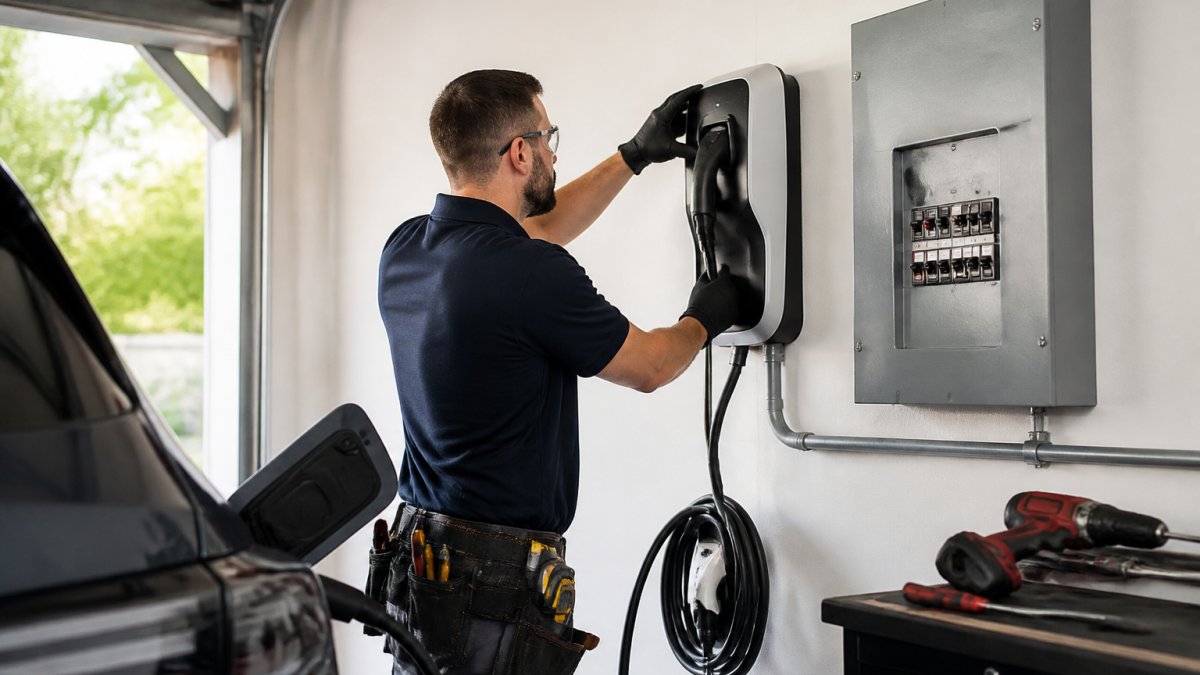
EV Charger Installation Requirements AS/NZS 3000
Every EV charger install must comply with AS/NZS 3000, the Wiring Rules, and the manufacturer’s instructions, covering RCD protection, amperage, voltage, cable sizing, and a safe cable run. A site assessment confirms this first.
A hardwired install is standard for most Level 2 charger units; pluggable options carry limits. Your electrical contractor should confirm which suits your home before quoting.
Skipping the site assessment can lead to undersized cable, nuisance tripping, and a second visit that costs more than doing it right the first time.
EV Charger Installation Cost Australia and Switchboard Upgrade for EV Charger
We do not publish fixed prices because EV charger installation cost Australia-wide varies with site conditions. The main drivers are the switchboard upgrade, cable run length, and whether load management is needed.
A switchboard upgrade is often the biggest line item: older boards may lack space, RCD protection, or capacity for a new dedicated circuit.
| Cost Driver | Why It Matters | Time Impact |
|---|---|---|
| Switchboard upgrade | Adds capacity and safety protection | Adds a day or more |
| Cable run length | Longer runs need more cable and labour | Adds 1-3 hours |
| Load management | Balances charger draw with home use | Adds 1-2 hours |
| Hardwired vs plug-in | Hardwired needs fixed wiring | Minimal difference |
| Site access | Tight roofs and walls slow the work | Varies widely |
For an accurate figure, request an upfront quote after a site visit, a phone estimate is never reliable.
Ask your electrician to check grid capacity and future EV charging infrastructure needs at the same time. If a second EV is likely, sizing the circuit now saves a full rewire later.
Adding a home charger is a project, not a quick swap, and the details decide whether it runs smoothly. Smart elec handles the whole job for Tablelands homes, farms, and businesses, from the site assessment and switchboard upgrade to the final safety certification. Our team brings over 13 years of local experience and an award-winning record for honest, reliable work. Get started with Smart elec and charge at home with confidence.