


Last Updated: September 14, 2026
Bore Pump Electrical System Installation: What You Need to Know
Most rural water system failures trace back to the electrical side, not the pump. With over 13 years of experience, we’ve observed common, avoidable mistakes repeating in bore pump wiring and repairs.
A bore pump electrical system is every component supplying, controlling and protecting power to a submersible pump in a borehole: motor, motor lead, cable splice, control box, pressure switch, and safety and earthing conductors.
Before any cable goes down the hole, check static water level, drawdown and pump curve against your required flow rate, and confirm supply type, voltage and amperage. Undersized cable is a leading cause of premature motor failure, the motor overheats without enough voltage (pubmed.ncbi.nlm.nih.gov).
The 6 core requirements: site assessment (bore depth, water level, supply capacity); correct cable sizing; waterproof splicing with a splice kit and heat shrink; a safety cable so the pump’s weight never hangs on the cable; a sealed bore cap and wellhead connection; and testing and commissioning before handover.
[Safe Work Australia’s guide to electrical safety(/rural-electrical-maintenance-why-electrical-maintenance-matters-rural-properties/) | safeworkaustralia.gov.au] is clear that electrical work on installations like this must be done by a licensed electrician. That’s not a technicality. Water and electricity in a deep borehole is a genuinely dangerous combination, and an unlicensed install can void insurance and fail a compliance inspection.
Never use the pump’s electrical cable to lower the pump into the bore (worksafe.qld.gov.au). The cable is not a load-bearing component, and stretching it damages the insulation and conductors. Always use a dedicated safety cable rated for the pump’s weight.
Step-by-Step: Installing the Bore Pump Control Box
Installing a bore pump control box is where most DIY attempts go wrong. It houses the motor’s starting components, overload protection, and the terminals where supply, motor lead and pressure switch meet, wire it wrong and you can burn out a brand-new motor on first start.
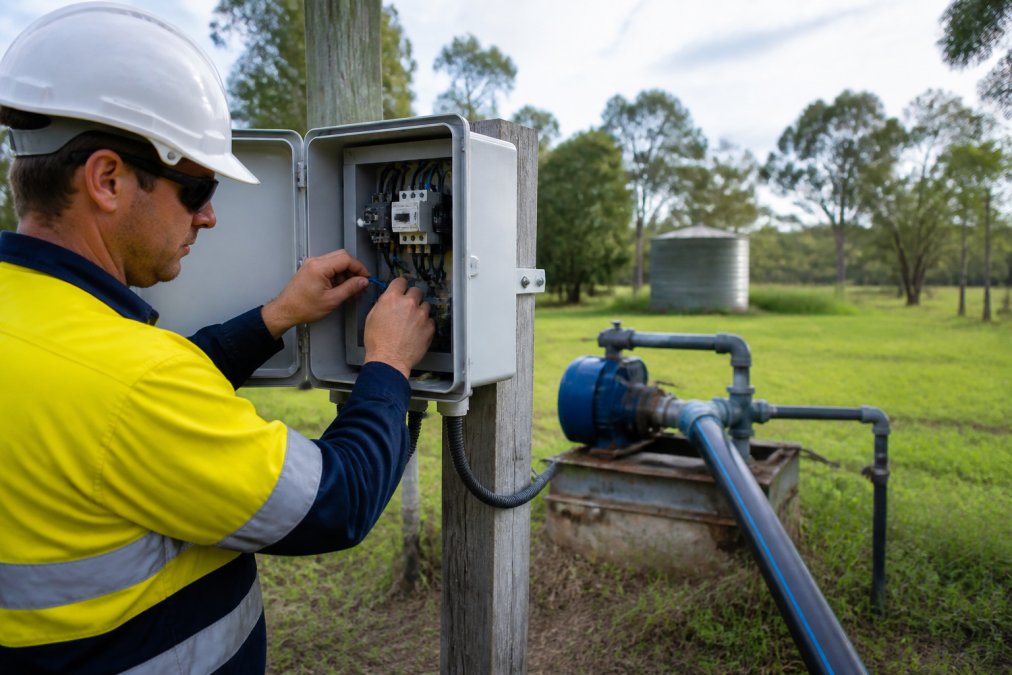
Work through it in this order:
- Isolate and lock out the supply, confirming dead with a tester.
- Mount the control box dry, shaded, near the wellhead and above flood level.
- Bring the supply cable in through a cable gland so the enclosure stays sealed.
- Terminate the motor lead, supply and pressure switch per the wiring diagram, single-phase, three-phase and capacitor start boxes differ.
- Fit a torque arrestor above the pump if it kicks on start-up.
- Earth the installation with a ground rod at the wellhead for fault current and lightning protection.
- Megger-test insulation resistance before energising, below the manufacturer’s minimum means a damaged cable or splice, so don’t apply power.
| Step | What to Check | Why It Matters |
|---|---|---|
| Cable sizing | Voltage drop over the run length | Undersized cable overheats the motor |
| Splice | Waterproof heat shrink and splice kit | Water ingress shorts the motor lead |
| Safety cable | Rated for pump weight | Protects the electrical cable from load |
| Earthing | Ground rod and bonding | Fault current and lightning protection |
| Megger test | Insulation resistance reading | Confirms no damage before power-up |
Skipping the megger test because the pump "looks fine" is common, a damaged splice can read normal until under load, and by then the motor is already failing.
Photograph the control box wiring before you disconnect anything, and keep the wiring diagram inside the enclosure. When a fault happens months later, you’ll thank yourself for the reference.
Electrical Safety for Rural Water Systems and Troubleshooting
Electrical safety for rural water systems means protecting the motor, the cable and the people working on them. Rural supplies sit at the end of long lines, so voltage drop, poor earthing and lightning exposure are far bigger issues than in town.
When a bore pump stops working, work through the likely causes in order:
- No power at the control box: check the circuit breaker, pressure switch and supply voltage.
- Breaker trips on start: suspect a short in the cable splice, a failed capacitor, or a seized motor.
- Pump runs but no water: likely mechanical, check the water level and pump position in the bore.
- Thermal overload tripping repeatedly: usually low voltage, an undersized cable, or excessive amperage draw.
Farm reticulation often shares a supply, so a bore circuit fault can show up as nuisance tripping elsewhere. Keep the bore pump on its own protected circuit where possible.
If the thermal overload keeps tripping, stop resetting it. Repeated tripping points to an underlying fault, and forcing the pump to run will destroy the motor.
When to Call a Licensed Electrician
Some jobs are worth doing yourself, bore pump electrical work is not one of them. Buried cable, water, high starting currents and rural earthing mean a mistake can cost far more than the original install.
Smart elec handles bore pump electrical systems, switchboard upgrades and rural property wiring across the region. If your control box needs replacing, your cable needs re-splicing, or you’re commissioning a new bore, our licensed electricians can test, fault-find and certify the installation properly.
Bore pump electrical faults rarely fix themselves, and a pump running on a bad circuit will eventually fail at the worst possible time. Smart elec brings over 13 years of rural and commercial electrical experience to every job, from control box installation and cable splicing to switchboard upgrades and full system testing. Get started with Smart elec and get your bore pump running safely, efficiently and to standard.