


Last Updated: September 12, 2026
Step 1: Plan Your Farm Shed Power Supply and Site Inspection
Learning how to wire a farm shed for power starts with a plan and site inspection: list every load, mark the route, locate services via Dial Before You Dig, measure the distance from the main switchboard, decide single- or three-phase, confirm supply capacity, and book a licensed electrician.
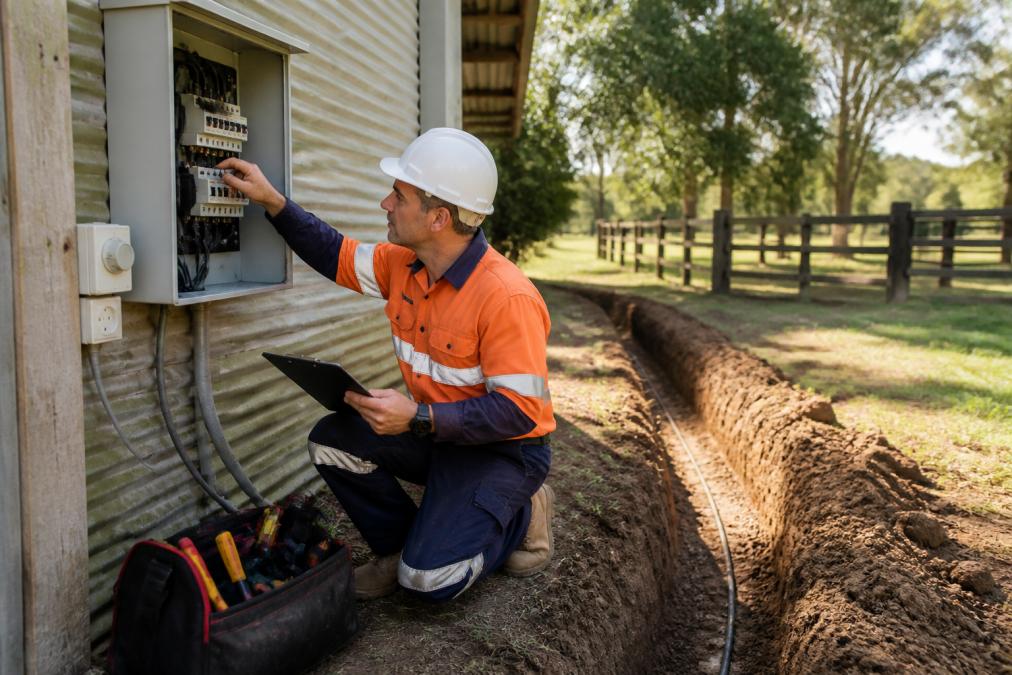
Electrical work in a farm shed is not a DIY job (worksafe.qld.gov.au). Switchboard connection, sub-board installation and certification all sit with a licensed electrician. Smart elec has spent over 13 years on rural properties.
Skipping the site inspection and guessing at cable size is the most expensive mistake in shed wiring. Undersized cable causes voltage drop, nuisance tripping and, in the worst case, overheating.
Underground Electrical Cable Requirements for Sheds
Underground electrical cable requirements for sheds come down to cable type, depth and protection: SWA direct buried, cable in PVC conduit, or overhead catenary, depending on ground conditions, route and budget.
| Method | Best For | Key Advantage | Watch Out For |
|---|---|---|---|
| SWA cable direct buried | Long runs, rocky or uneven ground | Armour protects against knocks and digging | Needs correct glanding and termination |
| Cable in PVC conduit | Shorter runs, routes with future access | Easier to pull additional cable later | Conduit can crush if buried too shallow |
| Overhead catenary | Routes where trenching is impractical | Avoids excavation entirely | Clearance and support requirements apply |
Cable must be rated for underground use, sized for load and distance, buried deep enough that farm activity won’t disturb it, bedded with sand and warning tape, and separated from water.
Photograph the trench and cable route before backfilling, with a tape measure in frame for depth. That photo record is worth more than any written note.
Electrical Safety Compliance for Outbuildings
Electrical safety compliance for outbuildings is not optional. Shed circuits need RCD protection, breaker sizing matched to cable capacity, earthing and bonding, a labelled sub-board, and certification by a licensed electrician (esv.vic.gov.au).
Compliance isn’t a one-time box to tick. Every time you add a major load to a shed, the protection and cable sizing should be re-checked.
How to Calculate Voltage Drop for a Long Shed Run
Voltage drop is the loss of voltage along a cable as current flows, caused by conductor resistance over distance. Distance, current, cable size and conductor material all drive it, so on long rural runs, upsize the cable, the extra cost is trivial next to re-trenching.
Never size shed cable by matching the breaker to the load and ignoring distance. Undersized cable on a long run causes dimming lights, struggling motors and premature equipment failure.
Cost Breakdown: What Drives the Price of Shed Power
Shed power pricing depends on distance, cable size, ground conditions and site work.
| Cost Driver | Why It Matters |
|---|---|
| Distance from switchboard | Longer runs need more cable and heavier gauge |
| Cable type and size | SWA and larger gauges cost more than standard cable |
| Trenching and ground conditions | Rock, concrete and tree roots add labour and time |
A site inspection is the only way to quote honestly. Smart elec provides itemised quotes for rural shed power after inspecting the site.
Smart Shed Integration and Future-Proofing
Plan for future loads now: spare sub-board capacity, a larger cable than strictly needed, conduit with a drawstring for comms, and provision for solar, battery and EV charging.
Off-Grid vs Grid-Tied Shed Power
For sheds far from the main supply, off-grid can beat a long grid connection. Grid-tied runs cable from the main switchboard and suits nearby sheds; off-grid uses solar, a battery and an inverter for remote sheds or light loads.
| Factor | Grid-Tied | Off-Grid |
|---|---|---|
| Best for | Sheds close to main supply | Remote sheds, long runs |
| Upfront cost | Lower for short runs | Higher equipment cost |
| Heavy loads | Handles large loads easily | Limited by battery and inverter |
The deciding factor is usually distance and load, a licensed electrician can run the comparison for your property.
Why This Work Belongs With a Licensed Electrician
Load calculation, voltage drop checks and final certification must be done by a licensed electrical contractor. Getting it wrong risks shock, fire, failed equipment and insurance problems.
Knowing how to wire a farm shed for power is a job where planning matters more than digging. Smart elec has spent over 13 years powering rural properties, backed by a 4.9-star rating across 44 Google reviews and multiple Tablelands Regional Council Business Excellence Awards.
Get started with Smart elec and power your shed safely, compliantly and for the long haul.