


Last Updated: September 15, 2026
What a Rural Property Electrical Safety Review Covers
A rural property electrical safety review is a documented assessment of every electrical asset on a farm, acreage or rural business, from the switchboard and sub-circuits to pump controllers, sheds and outbuildings. At Smart elec, we treat it as a full-system audit, because rural installations face risks suburban homes never see: long cable runs, seasonal moisture, livestock, machinery vibration and lightning exposure.
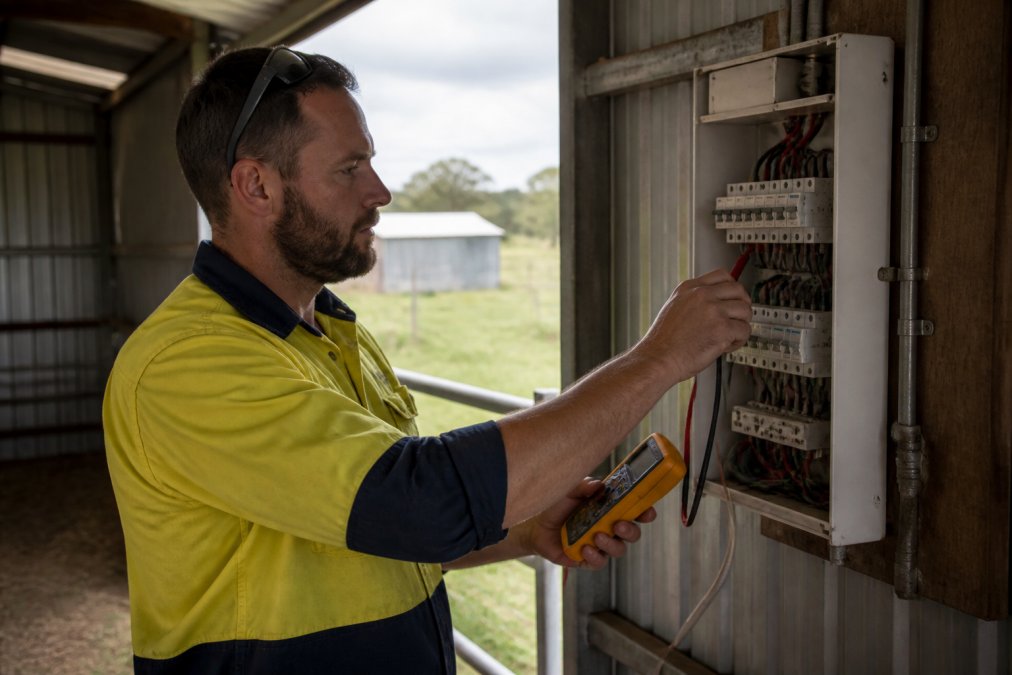
Scope changes with the property: a grazing block with one shed needs less than a poultry operation running three-phase augers and a packing shed.
AS/NZS 3000 Wiring Rules and What They Mean for Your Place
The AS/NZS 3000 wiring rules are the mandatory standard for all electrical installations, and rural properties face stricter practical demands under them: voltage drop limits on long submain runs, mandatory RCD protection on final subcircuits, and specific earthing requirements for outbuildings and pump equipment (Wiring Rules). Standards Australia on AS/NZS 3000 publishes the current edition, and any electrician quoting work should be working to it.
A common mistake on rural blocks is running a submain to a shed without checking voltage drop. The cable carries the load on paper, but the pump motor runs hot, trips its thermal overload, and eventually fails years early. The fix costs far less than the replacement.
What an Electrical Safety Inspection Cost Actually Buys You
An electrical safety inspection cost reflects time on site, testing scope and documentation, not just a visual walk-through.
Ask any electrician for their test results in writing, not just a verbal summary. Insulation resistance and fault-loop impedance readings are the difference between a real review and a visual glance. If a quote does not mention testing equipment, it is a checklist, not an inspection.